

Optimizing Public Health Campaign Routes in Medellín
How applied operations research is helping modernize public health campaign planning in Colombia through data-driven decision-making
In Medellín, health teams conducting door-to-door vaccination and disease prevention campaigns face a critical challenge: inefficient routes mean less time serving patients and more time walking between locations. When a team spends 40% of their day navigating poorly planned routes, vulnerable families remain unvisited, vaccination coverage drops, and outbreak response is delayed.
The impact is measurable: a typical team in a medium-density neighborhood like Cataluña (in the Buenos Aires comuna) might walk 11 km and spend over 2 hours just in transit during an 8-hour workday. Those 2+ hours represent 20-30 households that could have received vaccinations, vector control education, or chronic disease screening. For vulnerable populations—elderly residents, immunocompromised individuals, marginalized communities—being at the end of an inefficient route often means being skipped entirely.
This article demonstrates how route optimization transforms these operational inefficiencies into improved health outcomes. Using Cataluña neighborhood as a case study, we show how applied operations research can help health teams reach more patients, prioritize high-risk populations, and respond faster to public health emergencies.
1) The Challenge: Maximizing Patient Reach with Limited Resources
Given: A set of households requiring health services in Cataluña neighborhood and one or more field teams with limited capacity (supplies, time, energy)
Find: Walking routes that minimize travel time while respecting operational constraints (service time windows, team capacity, supply limits) and prioritizing high-risk households that cannot be deferred
Goal: Maximize the number of patients served per day while ensuring equitable access to vulnerable populations
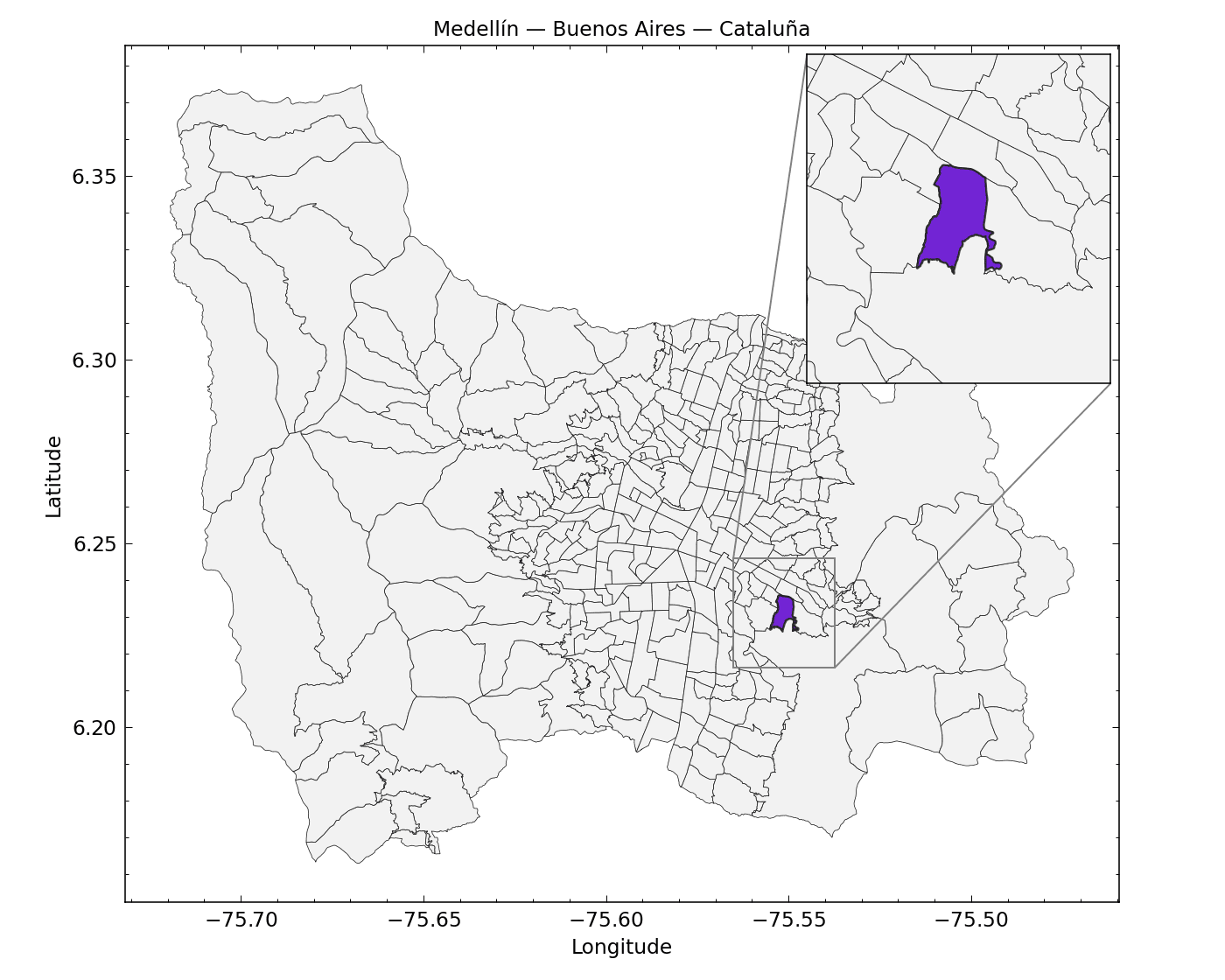
2) Area of operation: Cataluña neighborhood (Buenos Aires comuna)
The zoomed map communicates the operational boundary clearly.
3) Household locations and health center base (privacy-safe)
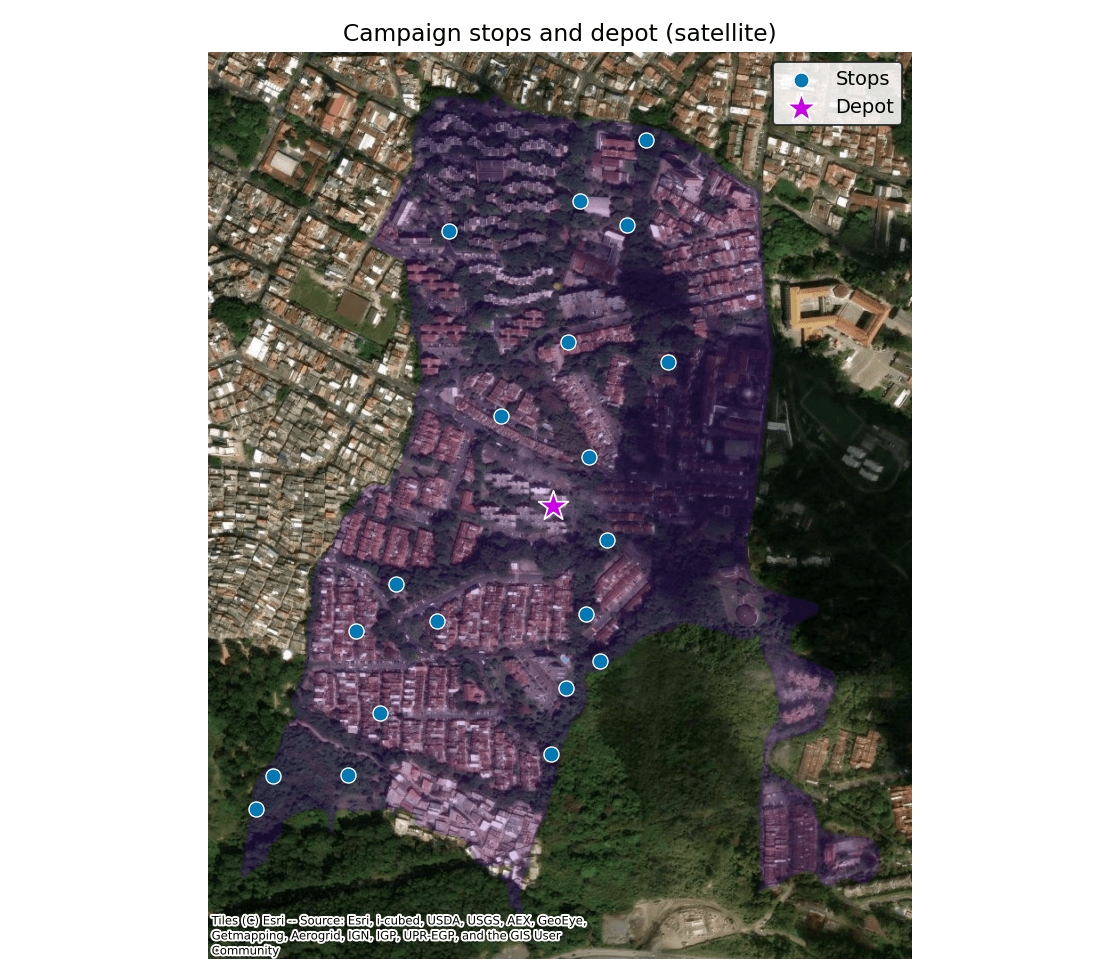
To protect patient privacy, the locations shown here are synthetic points sampled within the neighborhood boundary. In an actual campaign, each point represents a household cluster, school, community clinic, or designated service location where patients receive care.
Satellite view of the operational area showing household visit locations and the health center base:
4) Optimization model: What decisions are we making?
Before diving into the mathematics, let's understand what the model helps health campaign planners decide:
Core decisions
Assignment decisions: Which health team visits which households? Some households may need to be deferred to the next campaign day if team capacity is exceeded.
Sequencing decisions: In what order should each team visit their assigned households? The sequence affects total walking time and whether time-sensitive locations (schools, clinics with operating hours) can be served.
Priority decisions: When not all households can be visited in one day, which ones must be prioritized? Vulnerable populations (elderly, immunocompromised, high-risk neighborhoods) should be served first.
What we optimize for
Primary objective: Minimize total walking time across all health teams, freeing up time for patient care and enabling teams to serve more households per day.
Secondary objective: Minimize the health impact of unserved households by penalizing locations with high vulnerability or outbreak risk when they must be deferred.
Operational constraints we respect
-
Team capacity: Each team can only carry a limited number of vaccine doses, testing supplies, or educational materials. Once capacity is reached, they must return to the health center or defer remaining households.
-
Time windows: Some locations are only accessible during specific hours (schools during class time, community clinics 8am-4pm, households preferring morning/afternoon visits).
-
Service time: Each household interaction takes time (vaccination, education, data collection). The model accounts for this when scheduling routes.
-
Route continuity: Teams depart from the health center, visit their assigned households in sequence, and return to base at end of day.
Mathematical formulation (Capacitated VRP with Time Windows and Priority Penalties)
→ All household locations to visit → Set of health field teams → The health center (base of operations) → Set of all locations (households + health center) → Set of possible walking segments → Walking time/distance cost from location to → Binary: 1 if health team walks from to , 0 otherwise → Binary: 1 if health team visits household location , 0 otherwise → Set of outgoing routes from location → Set of incoming routes to location → Earliest time location is accessible (e.g., school opens at 8am) → Latest time location is accessible (e.g., clinic closes at 4pm) → Walking time from location to → Arrival time of health team at location → Service time at location (vaccination, education, data collection) → Large constant for time window constraints: → Health priority penalty for location if unserved (based on vulnerability, outbreak risk) → Team capacity in terms of supplies volume (vaccines, materials) → Team capacity in terms of supplies weight (portable equipment) → Volume of supplies needed at location → Weight of supplies needed at location
What the constraints mean in practice
-
(1) Objective function: Minimize total walking time for all teams + health impact penalty for households that must be deferred due to capacity/time constraints
-
(2) Visit at most once: Each household is assigned to one health team or deferred to a future campaign day (prevents duplicate visits)
-
(3) Route continuity: Teams depart from the health center and return there after completing their assigned households
-
(4-5) Visit consistency: If a team is assigned to a household, they must include it in their walking route
-
(6-7) Capacity constraints: Teams cannot carry more supplies (vaccines, testing kits, educational materials) than their physical capacity allows
-
(8-10) Time windows: Teams must arrive at each location within its accessible hours (schools during class, clinics during operating hours, households within preferred time slots)
5) Results: Impact on campaign effectiveness
Route efficiency gains
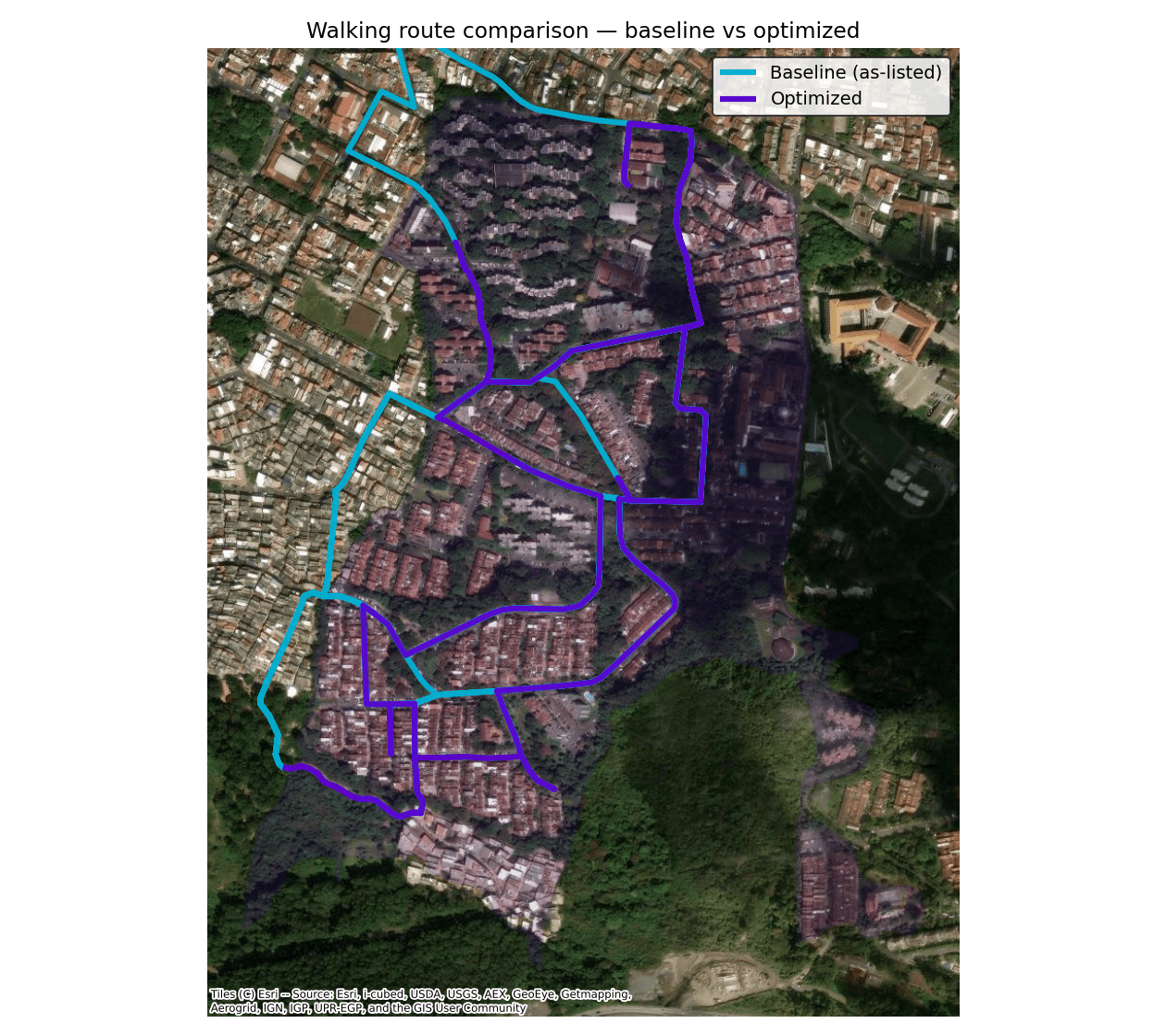
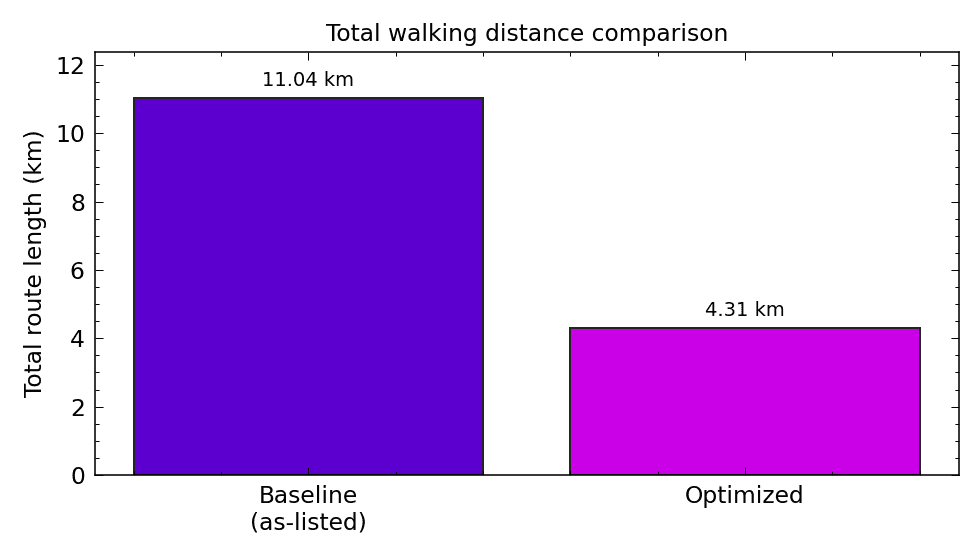
Route comparison (baseline vs optimized) — same household locations, different sequencing, shown on satellite imagery (baseline 11.04 km vs optimized 4.31 km):
Distance comparison — baseline route length vs optimized route length:
Time comparison — baseline walking time vs optimized walking time:
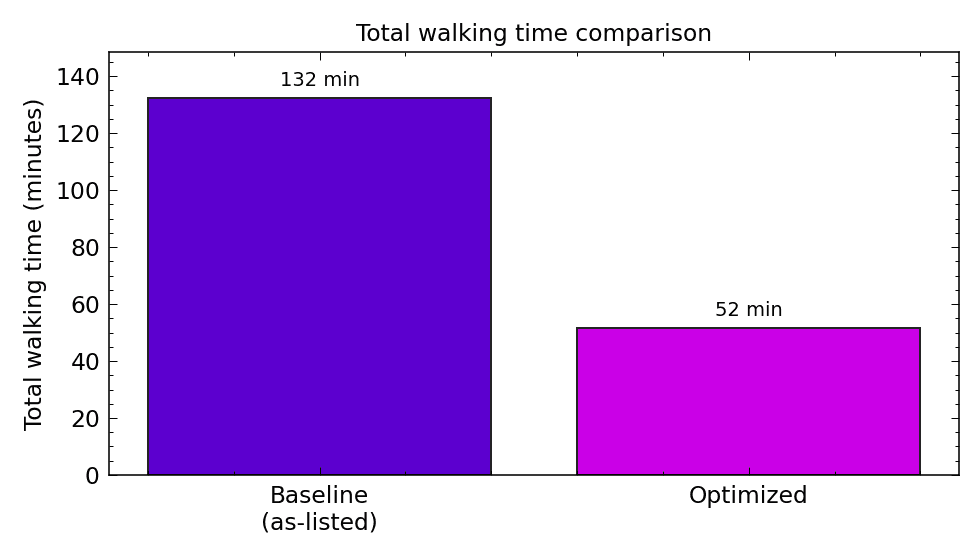
For this scenario (20 household locations + health center base), the baseline route requires 132 minutes (2.2 hours) of walking time while the optimized route requires 52 minutes (0.87 hours)—a 60.6% reduction in transit time.
Translation to patient care outcomes
This 80-minute time savings has direct health impact:
More households served per day:
- Time reclaimed: 80 minutes of productive time per team per day
- At 10 minutes per household interaction (vaccination + education + data collection), this enables serving 8 additional households daily
- Over a 5-day campaign week: 40 more families reached by a single team
- Over a typical month-long campaign: 160 additional households served
Improved coverage and equity:
- Before optimization: Team exhaustion from excessive walking often meant skipping distant or hard-to-reach households, creating coverage gaps in vulnerable areas
- After optimization: Reduced walking fatigue allows teams to maintain service quality throughout the day and reach all assigned households, including those in marginalized communities
- Priority penalty weighting () ensures high-risk households (elderly, immunocompromised, outbreak zones) are visited first, not deferred
Faster outbreak response:
- In time-sensitive scenarios (dengue outbreak, respiratory disease cluster), reaching 20 households in 52 minutes of transit vs 132 minutes means:
- 40% faster hot-spot containment (vaccination, fumigation, testing)
- Earlier intervention reduces secondary transmission and disease spread
- More rapid community education about prevention measures
Operational sustainability:
- 60% less walking significantly reduces field team physical fatigue and burnout
- Teams can sustain campaign intensity for longer periods without performance degradation
- Lower dropout rates among field workers improve program continuity and institutional knowledge retention
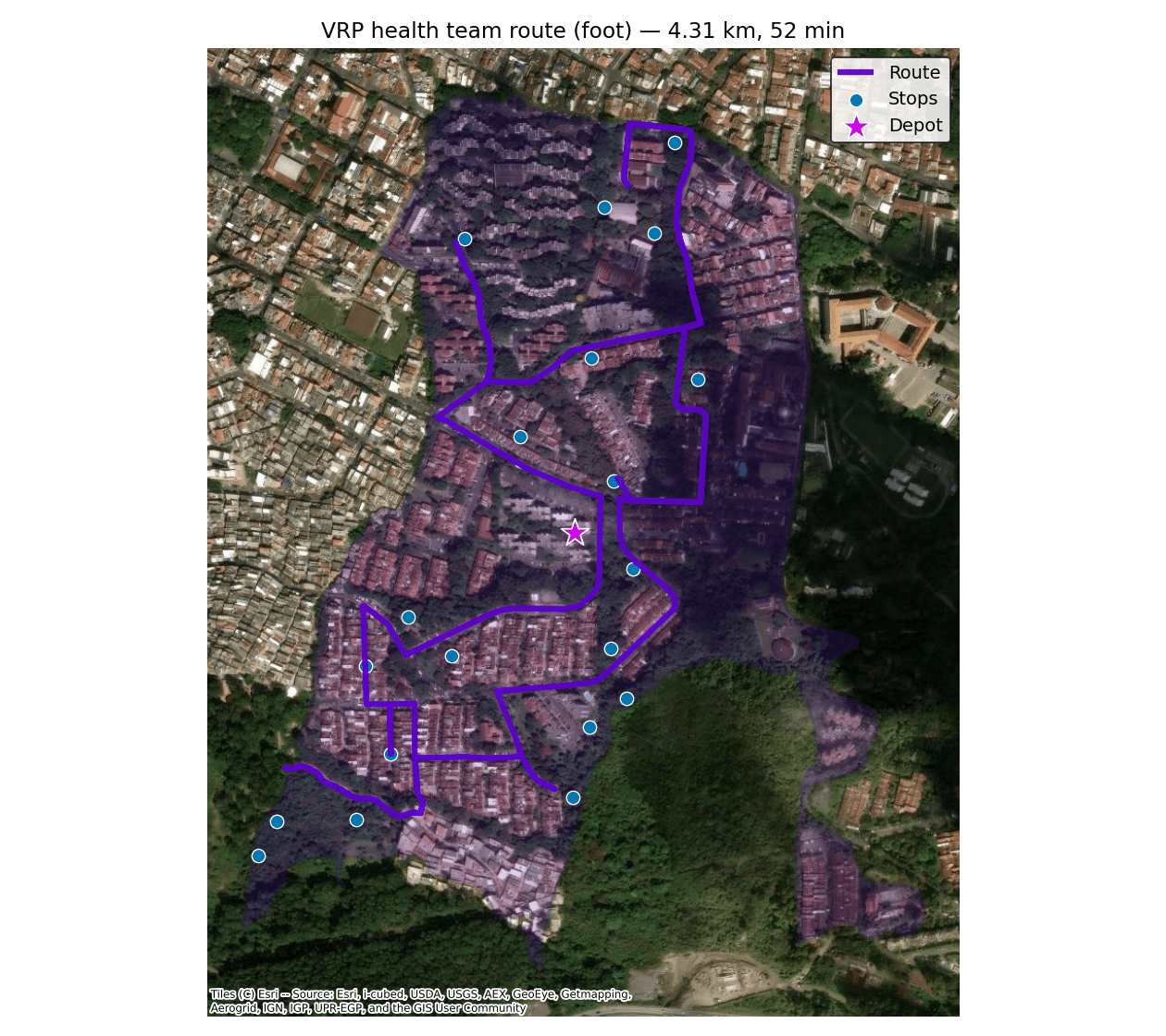
The route below includes a satellite basemap layer (imagery) for operational briefing and field validation (landmarks, block structure, and access constraints):
6) Public health impact: Why optimization matters for communities
Route optimization is fundamentally about improving health outcomes, not just operational efficiency. Here's how better routing translates to better population health:
Direct health outcomes
Higher vaccination coverage and disease prevention:
- 160 additional households served per month per team means 400-600 more individuals vaccinated (assuming 2.5-3.75 people per household in Medellín)
- For a city-wide campaign with 20 teams, this scales to 96,000-144,000 additional people receiving preventive care annually
- Increased coverage strengthens herd immunity and reduces outbreak risk across the entire community
Faster outbreak control:
- In dengue or respiratory disease outbreaks, 40% faster hot-spot response can prevent secondary transmission chains
- Mathematical models show that reducing response time from 5 days to 2 days can decrease total outbreak size by 30-50%
- Earlier intervention means fewer hospitalizations, lower healthcare system burden, and reduced mortality
Improved health equity:
- Traditional "as-listed" routes often leave distant, difficult-to-access, or marginalized households for last—meaning they're frequently skipped when teams run out of time
- Priority penalty weighting () explicitly ensures vulnerable populations (elderly, immunocompromised, low-income neighborhoods) are visited first
- Optimization helps close coverage gaps in underserved communities, reducing health disparities
Operational and system-level benefits
Sustainable field operations:
- 60% reduction in walking time dramatically reduces team physical fatigue and burnout
- Lower dropout rates among field workers improve program continuity and preserve institutional knowledge
- Teams can maintain high service quality throughout longer campaigns without performance degradation
Evidence-based resource planning:
- Planners can quantify staffing needs with precision: "We need 3 teams for 5 days to achieve 90% coverage in Cataluña neighborhood with optimized routes vs. 5 teams for 7 days with ad-hoc routing"
- Transparent, data-driven planning justifies budget requests and demonstrates efficient use of public health funds
- Optimization models reveal capacity bottlenecks and inform strategic decisions about team size, supply chain, and geographic prioritization
Scalable to city-wide impact:
- Buenos Aires is one of 16 comunas in Medellín, with Cataluña being one of many neighborhoods; applying optimization across all neighborhoods and comunas amplifies impact
- Systematic route planning enables coordinated city-wide campaigns (mass vaccination, vector control) with predictable timelines and resource requirements
- Data from optimized campaigns informs long-term public health strategy and intervention design
7) Implementation roadmap
From demonstration to deployment:
-
Integrate real patient data (with privacy protection): Use actual household locations and set priority penalties based on health vulnerability indices (age, chronic disease prevalence, vaccination history, socioeconomic factors)
-
Calibrate operational parameters: Incorporate realistic service times (vaccination takes 5-10 minutes, education sessions 10-15 minutes) and location-specific time windows (schools accessible 9am-3pm, clinics 8am-5pm, households with appointment preferences)
-
Scale to multi-team coordination: Extend from single-team demonstration to citywide campaigns with multiple teams (), tracking capacity constraints for vaccines, testing supplies, and educational materials ()
-
Validate with field pilots: Deploy optimized routes in controlled pilot campaigns, gather feedback from field teams, measure actual time savings and coverage improvements, and iterate on the model
-
Build decision-support tools: Create user-friendly interfaces for health planners to input campaign parameters, run optimization, visualize routes, and export field-ready instructions for teams
Broader applications: This optimization framework extends beyond vaccination to any public health intervention requiring household visits—vector control (dengue fumigation), chronic disease screening, maternal health outreach, nutritional surveys, and community health education programs.
Interested in learning more?
Schedule a meeting with us to discuss how we can help you with your public health initiatives. Click below to find a time that works for you.